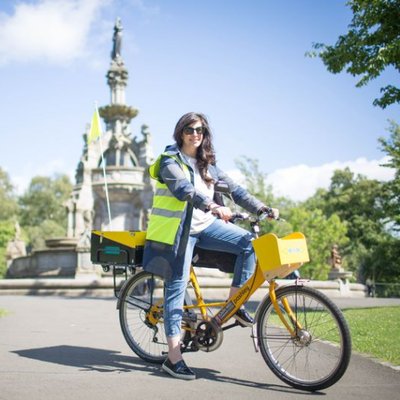
I work at the intersections of language, creativity and community engagement with migrant and minoritised communities in the UK, in particular with the Latin American communities in London and Scotland.
My interdisciplinary work with the Latin American migrant communities, largely builds on my academic experience in Latin American cultural studies, visual cultures and gender studies.
My research involves community planning, community dreaming, community engagement and community development, having co- delivered several projects and research outputs, including a report for Southwark Council assessing the needs and challenges faced by the Latin American communities in the borough.
In 2022, I joined the University of Glasgow as a Lecturer in Spanish. Previously, I lectured at the universities of St Andrews, Stirling, and the Open University in Scotland.
This website is primarily dedicated to my work on community engagement, although I work and have published on several topics related to Latin American Studies, including cinema and literature. I have not abandoned those topics, they have taken new forms.

A Spoken Word Piece Created During Research with the Latin American Community in London
Auto-historia teoría in a Spoken Word piece: https://vimeo.com/694615484
I am from the mountains
Migrants and racialised people are often confronted with questions about their origins and heritage. Sometimes these questions come from a genuine sense of curiosity; often, they serve as subtle or plain markers of racism and xenophobia.
The question of my origin sometimes arrives without warning, without any preamble, context, or apparent reason. I have found myself in situations where the question is asked as though it were self-evident that I should explain myself, account for my presence, and indeed my existence, my “Italian looks” and Spanish names, quirky accent, and fully explore my ancestry and migrant story in a 10-minute taxi journey.
I do appreciate the effort of making conversation, but at the back seat of a taxi, I always have the same conversation, at the point that I have practised so well the answer that the conversation is now shorter than it was during my first encounters. I have memorised my answers, so my story satisfies the listener: I am not from here and I never will.
Daughter of the mountains:
My surnames point to mountain origins. So when people ask, I say that I come from the mountains.
“Which mountains?”
Recently, I managed to investigate my ancestry and discovered that I descend from more than eighteen regions of the world. My origins, stretch across Africa and Europe, and include countries such as Romania, Italy, Spain, Portugal, and France, Senegal and the Hebrides. I come from the Apennines and the Alps, from Kilimanjaro and the Rwenzori Mountains, and the Highlands of Scotland, and yet I was born in a flat country of gentle rolling hills.
I descend both from those who stepped off ships to colonise and from those who were forced off ships in chains. I come from those who crossed oceans fleeing poverty and famine, those trafficked and enslaved, and from those escaping war and misery.
I recently learned that the visions I carried of witches burned at the stake were not merely imagined but concealed within my paternal family history. It turned out that my great aunties were all “curanderas”.
I also now know that my devotion to Yemanyá, the Yoruba goddess of the sea, was not simply because she is celebrated every year in the country where I was born, but because the sea connected me to the water, wind and land older than memory itself.
And yet, all of those pasts are and are not mine.
I am the coloniser and the colonised.
I am from the mountains. All of them.

